Leave Your Message

Top Rooting Hormone Powder Suppliers Worldwide

Choosing reliable suppliers matters when rooting success depends on more than a labeled jar. This guide examines the top Rooting Hormone Powder suppliers worldwide, with attention to formulation quality, manufacturing consistency, documentation, and professional support. Powder products may contain different auxins, carriers, and concentrations. These differences can affect callus formation, root emergence, and cutting survival. A product that performs well on softwood cuttings may disappoint with hardwood material. The plant species matters greatly.

Dr. Michael A. Dirr, a respected authority on woody plant propagation, wrote, “The ability to root cuttings is genetically controlled.” His statement remains essential for evaluating supplier claims. Rooting Hormone Powder cannot replace healthy stock plants, clean tools, suitable humidity, or correct temperature. It is one part of a living propagation system. Good suppliers should provide batch information, safety data, usage directions, and evidence of quality control. Independent laboratory testing is also valuable, although not every market publishes identical documentation.

This comparison considers global availability, technical transparency, packaging integrity, and customer experience. It also recognizes practical weaknesses. Online reviews may reflect poor technique rather than poor powder. Supplier rankings can change with new formulations, shipping limits, or regulatory requirements. Buyers should verify local rules before importing or applying any product. A careful choice begins with realistic expectations, not dramatic promises. Even experienced growers lose cuttings sometimes. That is part of the process.

Top Rooting Hormone Powder Suppliers Worldwide

What Is Rooting Hormone Powder and How Does It Work?

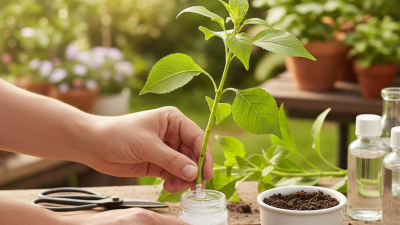
Rooting hormone powder is a propagation aid used on stem or leaf cuttings. It commonly contains an auxin, a plant-growth regulator that can encourage cells near a cut surface to form roots. The powder does not create roots by itself. The cutting still needs suitable moisture, warmth, light, and a healthy growing medium.

For a practical example, trim a healthy stem just below a node, then lightly moisten its base so a thin layer of powder can stick. Dip only the cut end, and tap off excess before placing it in a clean, pre-moistened medium. Follow the product’s directions: formulas and concentrations vary, and extra powder does not mean faster rooting. Keep leaves above the medium and avoid waterlogged conditions, which can invite rot. Clean tools matter, too.

Results differ by plant species, cutting age, and growing conditions. Some soft stems root readily without treatment; woody cuttings may respond more slowly. Check the medium with a fingertip rather than watering by habit. I have found this detail easy to overlook when several cuttings share one tray. A powder can improve the odds, but it cannot rescue a weak cutting or poor care. Watch for firm growth and new roots before moving a cutting into a larger pot.
Key Types and Active Ingredients Used in Rooting Hormone Powders

Top Rooting Hormone Powder Suppliers Worldwide

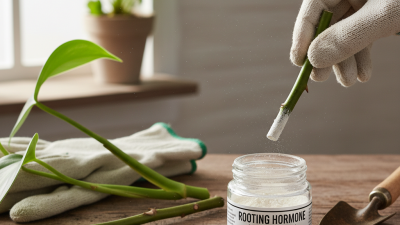
Rooting hormone powders usually rely on auxins, plant hormones that encourage new root formation. Indole-3-butyric acid, or IBA, is the most common active ingredient. It supports consistent rooting in many ornamental plants, shrubs, and woody cuttings. Naphthaleneacetic acid, known as NAA, can act more strongly at low concentrations. However, excessive NAA may damage tender tissue or slow root development. Indole-3-acetic acid, or IAA, occurs naturally in plants but breaks down more easily under light and heat.

The carrier matters. Talc-based powders cling well to freshly cut stems and remain easy to measure. Water-dispersible powders can spread more evenly, especially in nursery workflows. Some products combine IBA and NAA to balance speed and root quality. Others contain inert minerals that improve flow and reduce clumping. Always check the active ingredient percentage, batch details, storage guidance, and local registration requirements before purchasing from an international supplier.

In practical use, a thin coating is usually enough. Too much powder can form a dense layer around the cutting base. That layer may hold moisture and encourage decay. I have seen stronger formulations perform poorly on soft herbs, while milder powders worked better. Not always. Plant age, cutting thickness, humidity, and rooting media can change the result. A small trial with identical cuttings gives more reliable evidence than a supplier’s broad claim. Keep powders dry, sealed, and away from direct sunlight.

How to Evaluate Rooting Hormone Powder Suppliers Worldwide

Evaluating rooting hormone powder suppliers requires more than comparing price per kilogram. Check the active ingredient, concentration, carrier material, and particle consistency. Common formulations use indole-3-butyric acid or related plant-growth regulators. Ask for a current certificate of analysis, safety data sheet, batch number, and independent test results. The documents should match the delivered packaging.

Production discipline matters. Review manufacturing-site certifications, mixing controls, contamination testing, and storage conditions. A reliable supplier should explain how humidity affects powder flow and potency. The OECD-FAO Agricultural Outlook 2023–2032 links future crop growth mainly to productivity improvements, increasing the value of consistent propagation inputs. That connection is practical, not decorative.

Look for evidence from controlled trials, not only greenhouse photographs. Data should identify crop type, cutting age, application rate, rooting percentage, and observation period. Grand View Research reported strong growth in the global biostimulants market, with expanding demand for performance-based agricultural inputs. However, market growth does not prove supplier quality. Be careful there. Compare at least three batches and request a small sample before signing a long contract. Confirm export documentation, shelf-life testing, complaint handling, and local regulatory compliance. A polished website is weak evidence. Traceable records are stronger.

Manufacturing Standards, Quality Control, and Product Safety

Top Rooting Hormone Powder Suppliers Worldwide

Manufacturing standards shape the reliability of rooting hormone powders long before they reach a greenhouse. Responsible suppliers should document raw-material checks, batch formulation, and packaging conditions. A clean, dry production area helps limit contamination and moisture exposure. Ask whether each batch has a traceable code and a retained sample for follow-up testing. Small details matter.

Quality control should cover more than appearance. A consistent powder texture can support even measuring and application, but it does not prove the active ingredient is present at the stated level. Suppliers should use validated analytical methods and keep clear records of test results. Request a certificate of analysis, along with details about identity, strength, and relevant purity checks. Records should match the batch being purchased, not just a typical product specification.

Product safety depends on practical controls, too. Clear labels should explain handling, storage, and disposal, while safety data sheets should be current and easy to obtain. Sealed containers can reduce spills and protect powder from humidity during transit. Buyers should check that packaging arrives intact and instructions are readable in the intended market. I would still inspect a sample before a large order; paperwork can look polished, yet real handling sometimes reveals gaps. No system is perfect. A supplier’s willingness to investigate complaints and explain corrective actions is a useful sign of dependable quality practice.

Global Supplier Comparison by Applications, Certifications, and Support

Choosing among top rooting hormone powder suppliers worldwide requires comparing real use cases, not catalog claims. Ask whether the powder suits softwood cuttings, hardwood cuttings, or nursery-scale propagation. Concentration, carrier, and application directions should be clear on the label. The FAO’s 2023 report on the State of Food Security and Nutrition estimated that 2.33 billion people faced moderate or severe food insecurity in 2022; dependable crop and plant production matters, though that figure does not measure rooting-product demand. For supplier checks, request a current safety data sheet, batch-specific certificate of analysis, and documented quality controls. ISO 9001 certification can indicate a quality-management system, but it does not prove a product will root every species reliably.

Compare support as carefully as certification. A capable supplier should explain trial conditions, storage limits, and how to assess rooting without promising uniform results. Ask for application guidance for your crop and growing medium, plus a clear process for handling inconsistent batches. Small trials help. Record cutting age, treatment time, temperature, and rooting percentage; these details make supplier claims easier to evaluate.

Tips: Test two or three concentrations on a small, labeled set of cuttings before wider use. Check that the supplier’s documents match the product batch, and keep the packaging and application record. Even good data can disappoint when plant material varies.

Top Rooting Hormone Powder Suppliers Worldwide — Global Supplier Comparison by Applications, Certifications, and Support

Supplier-neutral comparison of common rooting-powder product options and procurement checks. These are product and sourcing categories, not company-specific supplier rankings; availability, registration, and certification vary by market and product.

Product or sourcing category Typical applications Common active ingredient Formulation and use considerations Documents and compliance checks Useful supplier support
General-purpose propagation powder Rooting cuttings of many ornamental and herbaceous plants Indole-3-butyric acid (IBA) Powder is applied to the basal end of a cutting. Follow the product label for dose and application method; suitability depends on plant species and cutting condition. Verify the label, safety data sheet (SDS), active-ingredient concentration, batch identification, and local registration or sale requirements. Clear application instructions, storage guidance, and technical advice for trial use on the intended crop.
Woody-plant propagation powder Cuttings from shrubs, trees, and other woody ornamentals IBA, with concentration selected for the intended use Products may be offered at different concentrations. Avoid assuming one concentration is suitable for all species; test on a small batch and follow label directions. Check concentration units, product specifications, SDS, shelf life, and any crop- or jurisdiction-specific use restrictions. Species-appropriate guidance, trial protocols, and advice on handling and storage.
Softwood and semi-hardwood cutting powder Propagation of actively growing or partially mature cuttings IBA; some products may use other labeled plant-growth regulators Cutting maturity, temperature, humidity, and rooting medium affect results. The hormone is one part of the propagation process, not a guarantee of rooting. Confirm the active ingredient and concentration on the label; review SDS and local rules for plant-growth-regulator products. Practical guidance on dipping technique, sanitation, and small-scale evaluation.
Indole-3-acetic acid (IAA) based option Specialist propagation uses where the product label specifies an appropriate application Indole-3-acetic acid (IAA) IAA is a naturally occurring auxin and is generally less stable than IBA under some conditions. Check the stated storage conditions and expiry information. Review the product label, SDS, stability or storage information, and applicable local requirements. Current storage guidance and technical documentation for the specific formulation.
Private-label or contract-manufactured powder Retail, nursery, or agricultural distribution under a buyer’s own label Depends on the agreed specification; commonly IBA-based Agree on active ingredient, concentration, pack size, label language, and quality specifications before production. Confirm responsibility for product registration, label approval, SDS, batch records, and import documentation in each destination market. Document control, packaging options, lead-time information, and clear allocation of regulatory responsibilities.
Bulk or commercial propagation supply High-volume nursery and greenhouse propagation Specified by the buyer; IBA is commonly used in rooting products Assess packaging size, batch consistency, storage needs, and compatibility with the nursery’s documented propagation procedure. Request a certificate of analysis (when available), specification sheet, batch traceability information, SDS, and relevant local compliance documents. Reliable order communication, traceability support, and technical assistance for process evaluation.

Certification note: ISO 9001, where held, relates to a quality-management system and does not by itself certify a rooting product’s efficacy or authorize its sale. Ask suppliers to provide current, verifiable certificates and product-specific regulatory documents relevant to the destination market.